

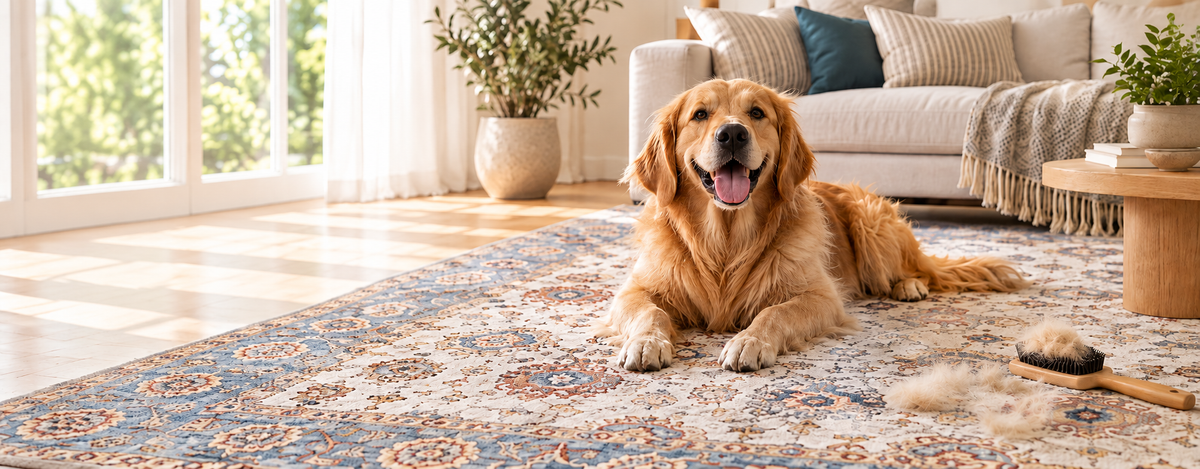
Who doesn't love dogs?
The tiny paws. The happy tail wags. The way they follow you from room to room just because they want to be wherever you are. The way their little presence can somehow make a house feel more like home.
For most dog parents, there's probably only one thing we'd happily live without: dog shedding.
Because somehow, the fur doesn't stay on the dog. It ends up on the couch, on your clothes, under the coffee table, in corners you just cleaned, and of course, all over your rug. If you've ever wondered how your dog can leave so much dog hair behind after what looked like a perfectly normal day, you're definitely not alone.
But here's something many dog owners don't realize: not all dogs shed the same way.
Using the American Kennel Club's most recent registration data, the 10 most popular purebred dog breeds in the U.S. span nearly the entire shedding spectrum, from a Poodle that barely leaves a trace to a Labrador that can fill a room with fur during a spring blowout. But registered purebreds aren't the whole picture: mixed-breed dogs and rescues outnumber any single purebred in American homes, so we've added them below too. Here's what all of it actually means for your floors, and what kind of rug and cleaning routine keeps up with each one.
The Real Pain Points Dog Owners Report
Before the breed breakdown, it's worth naming what actually frustrates people, because it's rarely just “there's hair on the rug”:
● Vacuuming multiple times a week and still seeing visible hair on the surface
● Hair that seems to come back after a wash, because it was never actually removed from the pad or backing underneath
● Dander and trapped fur triggering allergy symptoms in people who don't react to the dog itself, only to what's built up in the rug
● Odor that sets in when shedding season overlaps with muddy paws or an accident, and the two problems compound each other
● A rug that looks visibly worn or matted in the exact spot the dog sleeps or walks most, faster than the rest of the room ages
● Feeling like you have to choose between a rug you actually like and one that can handle the dog you actually have
Why Dog Hair Is Uniquely Hard on Rug Fibers?
Two things drive how much of a problem a breed's coat becomes on a rug, and neither one is really about breed name alone.
Coat type. Double-coated breeds carry a dense undercoat beneath a longer topcoat, and that undercoat “blows” out seasonally, usually spring and fall, releasing far more volume than day-to-day shedding. Single-coated breeds shed more consistently but in smaller amounts, with no dramatic seasonal spike.
Hair length and texture. Short, bristly hair (Beagles, Rottweilers) tends to work its way down into a rug's pile and grip there, while longer hair (Golden Retrievers) sits more on the surface and tangles into loops or shag textures. Curly or dense coats like a Poodle's often trap loose hair in the coat itself instead of dropping it at all, which is part of why they read as “low shedding” despite still growing and losing hair.

How to Clean Dog Hair Off a Rug, by Shedding Level?
The right routine depends on where your dog lands on the scale below, not just on how often you feel like vacuuming. For the full wash-and-dry routine by season, see our guide to caring for washable rugs year-round.
High shedders (Labrador, Golden Retriever, German Shepherd, Rottweiler)
● Vacuum every day or every other day with a pet-hair attachment during shedding season and machine wash following the care instructions.
● Use a rubber-bristle brush or squeegee across the pile first to lift embedded hair before vacuuming; a vacuum alone often just moves surface hair around
● Machine wash as needed, following the care instructions for your specific rug; blowout season is when you'll likely need it most
Medium shedders (Beagle, Rottweiler crossover, German Shorthaired Pointer)
● Regular vacuuming in a week; hair is shorter but consistent, so it doesn't need daily attention, just regular attention
● Machine wash as needed, following the care instructions for your specific rug, to clear what's worked into the base of the pile
Low shedders (French Bulldog, Poodle, Dachshund, Bulldog)
● A weekly vacuum generally keeps the surface clear
● Machine wash as needed, following the care instructions for your specific rug, or sooner if there's an odor or a spot that needs it; low shedding doesn't mean zero cleaning! a quick spot cleaning with a soft cloth and mild detergent will keep it looking fresh between washes.
The Most Common Dogs in U.S. Homes, Ranked by Shedding Level
The first 10 rankings reflect the AKC's most recent published registration data for purebred dogs, which is the most reliable named-breed data available. Mixed-breed dogs are added as their own entry, since they're not tracked by breed name but make up the largest single group of pet dogs in the country. Shedding levels are a practical range based on coat type and grooming/veterinary sources; individual dogs can vary. If you're weighing coat type against everyday mess more broadly, our guide to what actually makes a rug kid- and pet-friendly covers the construction side of that question.
|
Srl No |
Breed |
Shedding |
What it means for your rug |
|
1 |
French Bulldog |
Low–Medium |
Short single coat sheds lightly year-round. Hair is fine and short, so it tends to work into low-pile rugs rather than sit visibly on top. |
|
2 |
Labrador Retriever |
High |
Dense double coat sheds year-round with a heavy seasonal blowout. Undercoat buries deep into pile and is easy to underestimate until wash day. |
|
3 |
Golden Retriever |
High |
Double coat with feathering sheds heavily, especially at seasonal changes. Longer hair catches and tangles in looped or high-pile textures. |
|
4 |
German Shepherd |
High |
“Blows” coat twice a year but sheds noticeably in between. Owners often describe it as a near-constant, year-round task. |
|
5 |
Dachshund |
Low–Medium |
Smooth-coat Dachshunds shed lightly; long-haired and wire-haired varieties shed more. Coat type matters more than breed name here. |
|
6 |
Poodle |
Low |
Dense, curly coat traps loose hair rather than dropping it, so very little ends up on the rug. Requires professional grooming, but rug impact is minimal. |
|
7 |
Beagle |
Medium |
Short double coat sheds at a steady, low-grade rate year-round. Hair is short and bristly and can work into pile fibers rather than sitting on the surface. |
|
8 |
Rottweiler |
Medium–High |
Short, dense double coat sheds seasonally but in concentrated amounts. Hair is short but noticeably heavier during coat changes. |
|
9 |
German Shorthaired Pointer |
Medium |
Short single coat sheds modestly year-round with no dramatic seasonal spike. Hair tends to shed fairly cleanly off rug surfaces. |
|
10 |
Bulldog (English) |
Low–Medium |
Short single coat sheds lightly and steadily. Hair is short and doesn't burrow deep into pile the way a double coat's undercoat does. |
|
— |
Mixed-Breed / Rescue Dogs |
Varies (often Medium–High) |
The largest group of pet dogs in the U.S. isn't a registered breed at all, so there's no single shedding profile. A large share of mixed-breed dogs carry retriever, shepherd, or Lab ancestry, which leans toward a double coat. If you don't know your dog's coat type, it's safest to plan for a medium-to-high shedder until you learn otherwise. |
Whatever your dog's shedding level, the rug underneath it does most of the real work. Wyatt & Ash rugs are built fully machine washable, with a naturally stain-resistant pile, low-profile no-shed weave, and TPR non-slip backing, so a heavy-shedding week means a normal wash day, not a ruined rug. Browse the full Wyatt & Ash collection to see it in person.
Share:
How to Picture the Right Rug Size in Your Room Before You Buy
Ghost Your Stains: How to Get Halloween Messes Out of Your Rug (Candy, Face Paint, Mud and Pet Accidents)